



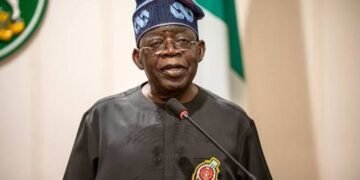















President Bola Ahmed Tinubu has attributed Nigeria’s long-standing revenue challenges and weak economic outcomes to a fragmented and outdated tax system, saying recent reforms are designed to improve efficiency, expand the tax base and support growth.
Speaking on Tuesday in Abuja at the commissioning of the headquarters of the Nigeria Revenue Service, the president said colonial-era tax laws created inconsistencies and distortions that limited productivity and undermined public confidence in the system.
Tinubu said the new tax framework, which became fully operational in January, aims to simplify compliance, eliminate duplication and create a more transparent and investment-friendly environment.
“Our direction is to build a revenue system that rewards enterprise, supports growth and ensures fairness,” he said, adding that the reforms are part of a broader effort to strengthen fiscal stability and restore credibility to economic management.
The president pointed to early signs of improvement, including stronger foreign reserves, improved fiscal conditions and rising investor confidence, which he said reflect the impact of ongoing policy changes.
The new NRS headquarters, a 16-storey facility completed after more than two decades since its foundation was laid, is expected to serve as a central hub for revenue administration, housing about 3,000 staff and key operational infrastructure.
Senate President Godswill Akpabio said recent economic reforms are beginning to yield results, citing improved fuel availability and increased domestic production. He urged Nigerians to remain patient as the measures take full effect.
Speaker of the House of Representatives Tajudeen Abbas said the reforms have addressed structural weaknesses in the tax system, including overlapping mandates and fragmented legal frameworks, which previously constrained revenue performance.
In his remarks, the Executive Chairman of the NRS, Zacch Adedeji, said the reforms consolidated more than 60 tax laws into a unified framework aimed at improving compliance, predictability and administrative efficiency. He said revenue collection increased from ₦6.8 trillion five years ago to ₦28.7 trillion in 2025.
Adedeji added that broader fiscal reforms have strengthened public finance management, improved remittance systems and enhanced transparency. He also highlighted the rollout of the National Single Window platform as a key step in modernising trade processes and boosting government revenue.
Tinubu said the reforms are not intended to raise tax burdens but to create a more efficient system with wider coverage and stronger governance.
He added that the new revenue framework is expected to deepen trust in public institutions by improving accountability and ensuring that tax contributions translate into tangible public value.