
















By Hamisu Hamza
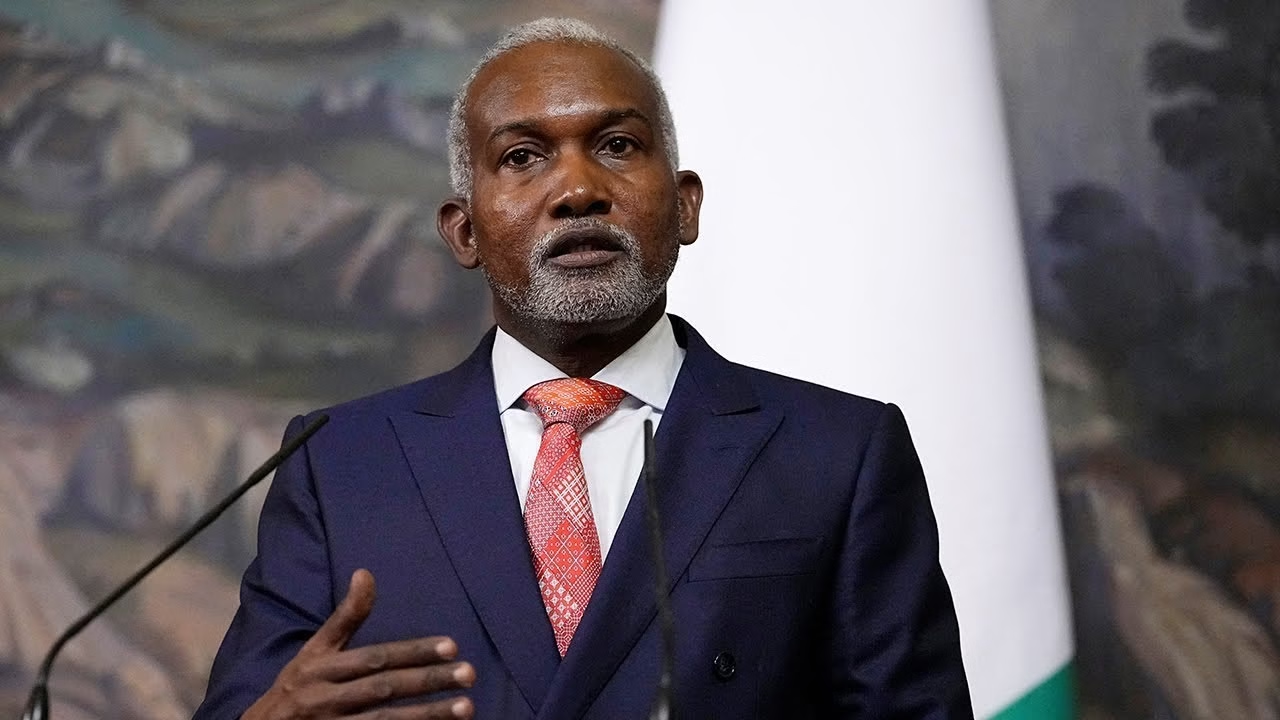
At his formal declaration held at the Games Village in Bauchi, Yusuf Maitama Tuggar, former Minister of Foreign Affairs and frontline governorship aspirant under the All Progressives Congress (APC), began his journey toward the Bauchi Government House on a strong footing.
His message was clear and direct: governance must move beyond rhetoric to practical results, transparency, and measurable development. Tuggar made it known that leadership must be defined not by endless promises, but by the ability to “show the work” through policies that positively impact the lives of the people.
Why Tuggar?
Tuggar’s ambition is centered on repositioning Bauchi State into a leading force in agriculture, solid minerals development, commerce, and investment. His vision is to move the state from untapped potential to productive prosperity by utilizing its vast human and natural resources.
With a distinguished background spanning business, diplomacy, legislation, and public service, Tuggar possesses a rare blend of local understanding and international exposure. His experience at both national and global levels places him in a unique position to connect Bauchi to investment opportunities, particularly in sectors such as agriculture, rare earth minerals, and lithium deposits where the state holds enormous potential.
Beyond the boardrooms and diplomatic circles, Tuggar remains deeply connected to the grassroots. His upbringing and long-standing relationship with rural communities have given him firsthand understanding of the realities facing farmers, traders, youths, and ordinary citizens across the state.
This understanding is expected to shape policies that prioritize agricultural productivity, rural development, access to markets, job creation, and economic empowerment for local communities.
A Development-Driven Agenda
Tuggar’s blueprint for Bauchi revolves around service, progress, accountability, and institutional development. His agenda focuses strongly on:
– Workers’ welfare
– Security
– Education
– Healthcare
– Youth and women empowerment
– ICT and digital innovation
– Economic growth and investment
On workers’ welfare, emphasis will be placed on prompt payment of salaries and gratuities to uphold the dignity of civil servants and pensioners.
In the area of security, his approach is expected to combine intelligence-led strategies, stronger community engagement, and collaboration with security agencies and traditional institutions to tackle insecurity and social unrest.
His administration also aims to address unemployment, poverty, and drug abuse through targeted interventions, vocational development, entrepreneurship support, and skills acquisition programs for young people.
Education remains another critical pillar of his vision. Tuggar has consistently emphasized the need to reduce the number of out-of-school children, improve learning standards, expand vocational education, and promote digital literacy and ICT innovation in line with modern realities.
On healthcare, special attention is expected to be given to women, children, and vulnerable communities through improved access, affordability, and strengthened social protection systems.
Governance Built on Transparency and Institutions
One of the defining features of Tuggar’s public image is his emphasis on transparency, accountability, and institutional governance.
Rather than personality-driven leadership, he advocates for systems that are efficient, sustainable, and rooted in the rule of law. His approach reflects a belief that good governance is not built on slogans or media optics, but on discipline, consistency, and functional institutions.
His leadership style also places importance on collaboration with traditional rulers, religious leaders, community stakeholders, and development partners in fostering unity and social stability across Bauchi State.
A Profile Shaped by Experience
Tuggar’s journey from Bauchi to the international diplomatic stage reflects decades of experience across multiple sectors.
Before venturing fully into politics, he built a strong reputation in business and public affairs. During his time in the House of Representatives, he became known for advocating reforms in public procurement and accountability, demonstrating a governance philosophy rooted in due process and merit.
His role in advancing conversations around procurement reforms and institutional accountability further strengthened his reputation as a reform-minded leader.
At the diplomatic level, Tuggar served as Nigeria’s Ambassador to Germany, where he played significant roles in strengthening bilateral relations and advancing Nigeria’s interests abroad. His diplomatic engagements also contributed to efforts surrounding the return of looted Benin artefacts to Nigeria through sustained international dialogue.
As Minister of Foreign Affairs, Tuggar projected Nigeria’s voice strongly on major regional and global issues. His tenure reflected calm diplomacy, strategic engagement, and firm defense of national interest.
Among notable moments during his service was his involvement in securing the release of detained Nigerian military personnel in Burkina Faso through diplomatic negotiations. He also attracted attention internationally for firmly rejecting proposals suggesting the deportation of foreign criminal elements into Nigeria, insisting that the country must protect its sovereignty and security interests.
Economic Diplomacy and Global Networks
Tuggar’s understanding of global politics and economic diplomacy remains one of his strongest political advantages.
Over the years, he consistently promoted policies aimed at strengthening trade, attracting investment, supporting diaspora engagement, and building strategic international partnerships capable of supporting local economic growth.
His supporters believe this global network and exposure can translate into practical development opportunities for Bauchi State through foreign investment, industrial partnerships, agricultural expansion, and infrastructure development.
Leadership for a Changing World
In an era where governance increasingly requires innovation, strategic thinking, and global competitiveness, Tuggar is widely seen by many supporters as a leader prepared for the demands of the 21st century.
His ability to bridge traditional values with modern governance aspirations places him in a unique position among the current field of aspirants.
Supporters also point to his calm disposition, intellectual depth, and methodical approach to leadership as qualities that distinguish him politically.
Beyond politics and diplomacy, Tuggar has also impacted lives through the Yusuf Maitama Tuggar Foundation, which has supported communities across the 20 local government areas of Bauchi State through various humanitarian and empowerment initiatives.
The Bigger Question
As the 2027 governorship race gradually gathers momentum, many political observers believe the central question may no longer simply be who wants to govern Bauchi, but who possesses the experience, exposure, competence, and strategic vision required to move the state forward in a rapidly changing world.
To many supporters, Tuggar represents that possibility.
They see in him a leader capable of combining international experience with grassroots understanding, institutional reform with human development, and economic diplomacy with practical governance.
For them, Bauchi does not merely need another politician; it needs leadership driven by vision, accountability, courage, and results.
And in their view, Yusuf Maitama Tuggar embodies that direction for the future of Bauchi State.