















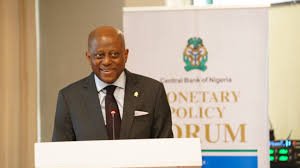
The Governor of the Central Bank of Nigeria, Mr. Olayemi Cardoso, has unveiled the Nigeria Payments System Vision (PSV) 2028, a strategic roadmap aimed at deepening payment infrastructure, expanding financial inclusion, accelerating innovation, and strengthening Nigeria’s integration with regional and global payment systems.
Speaking at the launch of the vision, Cardoso described PSV 2028 as more than a payments strategy, saying it represents a broader blueprint for how Nigerians will transact, trade, save, invest, and participate in the digital economy.
“Today, we don’t just unveil a payments strategy; we unveil a vision for how Nigerians will transact, trade, save, invest, and fully participate in a digital economy,” he said.
The CBN governor stressed that the initiative is a national project requiring collaboration across the public and private sectors. “PSV 2028 is not a government project. It is a Nigerian project,” he said.
Cardoso reaffirmed the apex bank’s commitment to creating an enabling environment for the growth of the payments ecosystem through innovation, regulation and stakeholder collaboration.
“We will continue to promote innovation while safeguarding stability, strengthen oversight while encouraging competition, and work collaboratively with stakeholders to ensure that our payments ecosystem evolves in line with both global standards and national priorities,” he said.
He noted that modern payment systems have evolved beyond simple fund transfers to become critical infrastructure for economic growth, financial inclusion and technological innovation.
According to him, the vision seeks to build a secure, resilient and globally competitive payments ecosystem while supporting broader CBN reforms aimed at strengthening economic stability, facilitating trade, boosting investor confidence and improving Nigeria’s external position.
Cardoso said the ultimate measure of success would be the impact on economic growth and poverty reduction.
“We must work together to ensure that we execute. Ultimately, we must measure performance by one thing: how it impacts GDP. The journey is to impact the lives of the poor, lead people out of poverty and have an impact on the GDP,” he stated.
The CBN governor expressed confidence that financial inclusion in Nigeria would rise to 95 per cent by 2028, bringing millions of market women, farmers and young Nigerians into the formal financial system.
“The goal is inclusion, not exclusion,” he said.
He also outlined an ambitious vision for a largely cashless economy, stating that cash should no longer dominate transactions by 2028.
“By 2028, cash should no longer be king. We need to do a lot more work to build trust and ensure people have no doubt they are dealing with a strong and reliable payment system,” Cardoso said.
On cybersecurity, he stressed that trust remains the foundation of any successful payment system, adding that the CBN aims to reduce fraud losses to less than one per cent of all transactions by 2028.
“A payment system is only as strong as the trust people have in it,” he said, noting that Nigerians should feel safer keeping money in digital channels than outside the formal financial system.
Cardoso further highlighted Nigeria’s growing influence in Africa’s payments landscape, citing the country’s scale, talent pool, entrepreneurial capacity and institutional foundations as key advantages.
He projected that the country’s fintech sector could produce globally competitive technology companies within the next few years.
“By 2028, Nigerian youth will launch the next global fintech unicorn right here from Lagos, Abuja, Calabar and beyond, using Nigerian data, Nigerian talent and solving Nigerian problems,” he said.
The CBN governor concluded that the success of PSV 2028 would depend not on the quality of the document itself, but on its implementation and ability to expand opportunities, strengthen trust, lower barriers to participation and create a payments ecosystem that serves all Nigerians.