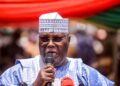









The Presidency has challenged former Vice-President Atiku Abubakar to provide details of his proposal to restore a targeted petrol subsidy if elected president, saying conflicting statements from his camp have created uncertainty over the policy.
Special Adviser to President Bola Ahmed Tinubu on Information and Strategy, Bayo Onanuga, said on Wednesday that Atiku and his aides had offered three different explanations of the former vice-president’s position on petrol subsidy within a week.
According to Onanuga, Atiku’s spokesperson, Paul Ibe, initially said Atiku would restore petrol subsidy if elected and subsequently phase it out, describing the measure as a temporary intervention to give Nigerians and businesses time to recover.
He said another senior aide, Phrank Shaibu, later rejected that interpretation, describing Ibe’s statement as an “unauthorised and misleading characterisation” of Atiku’s position.
Shaibu, according to Onanuga, said Atiku would not set a predetermined date for ending the subsidy but would retain it until domestic refining capacity expanded, fuel supply stabilised, competition deepened and market conditions allowed affordable petrol prices without government support.
Atiku subsequently intervened, saying his position had not changed and reiterating that he would restore a “targeted subsidy” if elected.
“I will restore targeted subsidy and put purchasing power back in the hands of Nigerians,” Atiku was quoted as saying.
Onanuga said the sequence of statements raised questions about the precise nature and implementation of Atiku’s proposed policy.
“Nigerians deserve clarity, not policy by trial and error,” he said.
Presidency questions petrol subsidy argument
The presidential aide also challenged the argument that restoring petrol subsidy would, on its own, significantly address Nigeria’s cost-of-living pressures.
While acknowledging the relationship between fuel prices, transportation and food costs, Onanuga said food inflation was driven by a broader range of factors, including agricultural productivity, insecurity, exchange rates, logistics, storage, flooding, input costs and supply constraints.
He argued that greater competition in the downstream petroleum sector could improve efficiency but would not completely insulate domestic pump prices from international crude oil prices, exchange-rate movements, refining costs, transportation and distribution expenses.
Onanuga also questioned Atiku’s apparent focus on petrol subsidy in relation to the different products obtained from crude oil refining.
He said petrol accounts for about 45 per cent of the products obtained from a refined barrel, while the remainder includes diesel, aviation fuel, kerosene, petrochemical feedstocks, asphalt, hydrocarbon gas liquids, lubricants, waxes, petroleum coke and sulphur.
The presidential aide noted that diesel was deregulated in 2004 during the Obasanjo administration, when Atiku served as vice-president. He added that kerosene and jet fuel were subsequently deregulated, with kerosene subsidies eventually removed.
He questioned whether a subsidy linked to crude oil would also extend to other products derived from the same barrel.
“Will Atiku subsidise all these by-products of the barrel as well, since kerosene is used by the underprivileged to cook, and many homes and factories use diesel to power generators and delivery trucks?” he asked.
Onanuga further questioned whether refineries supplied with discounted crude would retain the commercial benefits from other refined products while government support was concentrated on petrol.
Presidency seeks details of proposed subsidy
The Presidency called on Atiku to explain how his proposed targeted subsidy would operate, including its projected cost, beneficiaries, funding mechanism and the conditions that would determine when the intervention would end.
Onanuga warned against what he described as another potentially costly and opaque subsidy regime.
He argued that the removal of petrol subsidy under the Tinubu administration had improved government finances and contributed to efforts to stabilise the macroeconomic environment.
The Presidency’s criticism comes as petrol pricing and the broader cost-of-living crisis remain significant political issues ahead of the 2027 presidential election.
For the government, the debate centres on whether Nigeria should return to subsidising petrol or maintain the market-oriented framework introduced under the Tinubu administration. For Atiku, the proposed targeted intervention is being presented as a means of restoring purchasing power and easing pressure on households and businesses.
Onanuga, however, accused the former vice-president of offering a policy that remained insufficiently defined.
“The economy is too serious for policy somersaults, incoherence, destructive populism and election gimmicks,” he said.