








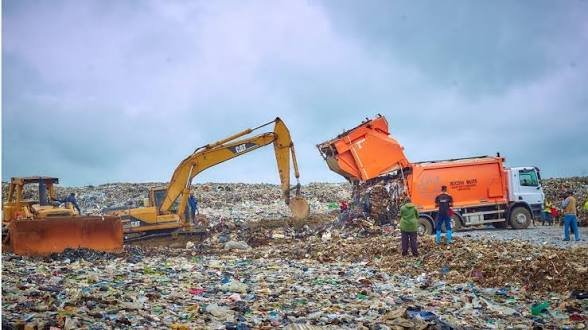
The Lagos Waste Management Authority (LAWMA) evacuated more than 18,660 metric tonnes of municipal solid waste across its disposal facilities in one week, as the rehabilitation of the Olusosun Disposal Facility access road and the opening of additional disposal platforms boosted operations by more than 76 per cent.
Managing Director and Chief Executive Officer of LAWMA, Dr. Muyiwa Gbadegesin, disclosed this during an operations review meeting at the Authority’s headquarters in Ijora-Olopa on Wednesday
He said LAWMA recorded 1,866 truck trips across its disposal facilities between July 28 and August 3, 2026, describing the performance as evidence of the positive impact of strategic infrastructure investment on waste evacuation across Lagos.
According to him, the Olusosun Disposal Facility accounted for 1,012 truck trips during the period, compared with 574 truck trips in the preceding week. That represents an increase of 438 truck trips, or more than 76 per cent over the previous week.
Gbadegesin attributed the improvement to the rehabilitation of the Olusosun access road and the addition of new waste disposal platforms, saying the intervention had reduced truck waiting times, improved turnaround and significantly strengthened the Authority’s waste evacuation capacity.
He said the improved performance reflected the impact of the Lagos State Government’s continued investment in critical waste management infrastructure under Governor Babajide Sanwo-Olu, adding that the intervention had addressed operational bottlenecks that previously slowed waste evacuation, particularly during the peak of the rainy season.
The LAWMA boss disclosed that the Authority recorded its highest daily throughput on August 1, when 349 truck trips, equivalent to about 3,490 metric tonnes of waste, were processed across its disposal facilities.
He added that the Ewu-Elepe, Badagry and Oke-Osho disposal facilities, alongside the Waste-to-Wealth Material Recovery Facility (WAEMRF) in Igando, continued to complement operations at Olusosun, ensuring efficient waste evacuation across different parts of the state.
Gbadegesin said the results demonstrated that sustained investment in critical infrastructure was translating into better waste management services for residents across Lagos.
“The steady improvement in our operational figures confirms that investment in critical infrastructure produces measurable results. We are witnessing faster truck turnaround, improved access to disposal facilities and increased waste evacuation capacity, all of which are translating into better service delivery for Lagos residents,” he said.
Looking ahead, he said LAWMA would consolidate the gains through the ongoing construction of modern Transfer Loading Stations, expansion of waste recovery infrastructure, development of waste-to-energy projects and the planned acquisition of additional compactor trucks to further strengthen waste collection and disposal logistics across the state.
Gbadegesin reaffirmed LAWMA’s commitment to supporting the Lagos State Government’s transition from a landfill-dependent waste management system to an integrated and sustainable model driven by resource recovery, recycling, waste-to-energy initiatives, circular economy principles and modern waste processing infrastructure.